Monthly Archives: July 2025
♣ Growing Pains
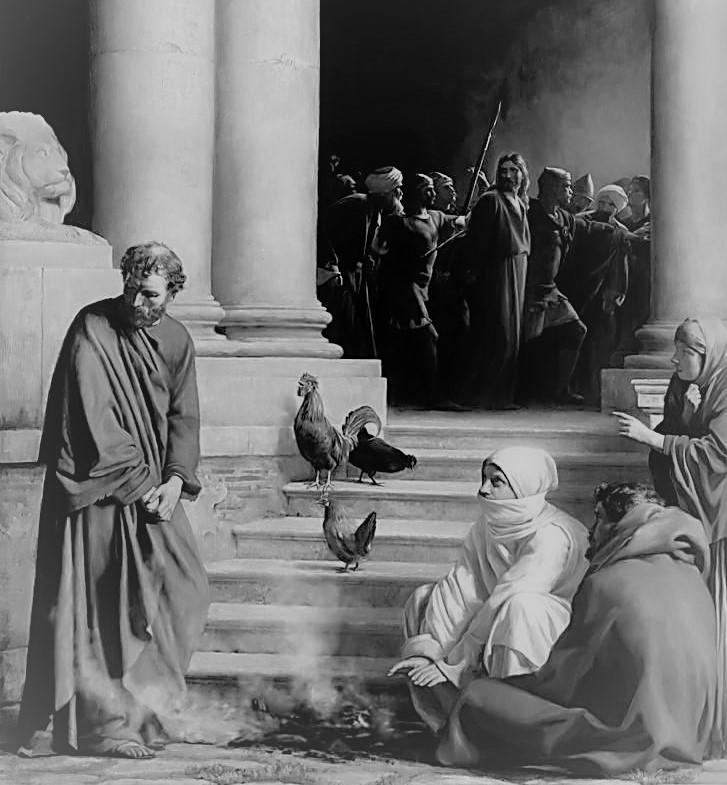
“Now Peter was sitting outside in the courtyard, and a slave woman came to him and said, “You too were with Jesus the Galilean.” But he denied it before them all, saying, “I do not know what you are talking about.” When he had gone out to the gateway, another slave woman saw him and said to those who were there, “This man was with Jesus of Nazareth.” And again he denied it, with an oath: “I do not know the man.” A little later the bystanders came up and said to Peter, “You really are one of them as well, since even the way you talk gives you away.” Then he began to curse and swear, “I do not know the Man!” And immediately a rooster crowed. And Peter remembered the statement that Jesus had made: “Before a rooster crows, you will deny Me three times.” And he went out and wept bitterly.” – Matthew 26:69-75
OFTENTIMES IT IS inspiring, as well as convicting, to read biographies of believers who lived remarkably fruitful and holy lives, but it can also be a disappointment to some of us to where there is almost a striking ourselves off the list as to not being truly regenerate because of certain sins we have committed after we are converted. We tend to imagine that despite change in our lives, the moment we are consciously aware of being born again, that we are no longer prone to falling, or making blunders we would be embarrassed and ashamed of. Oh! The very opposite can be true… at times.
It is imperative to maintain a biblical mindset in realising that to be a regenerate believer will inevitably manifest fruits of hating sin and seeing the world for what it is; this life no longer has a fascinating or bewitching hold on us as we know the shallowness and emptiness this world can only give. Sin is viewed differently as the Holy Spirit enables us with x-ray vision in discerning what sin and this world falsely promises to offer. What drives or motivates us is of another realm.
This is therefore encouragement to those who truly have the life of God in them and aspire to know Him, seeking to be conformed to Christ’s image – but yet acutely aware of their own failings, corruption within, or as some may have heard it said – the plague of their own hearts. The two natures within (as the apostle Paul refers to in Romans chapter seven and Galatians chapter five) that war against one another speak of dualism at times. It can be tormenting, to say the least, especially when we don’t know the Scriptures, and the Spirit of God relaying them to our hearts.
I draw our attention to three men – the first being Howell Harris (1714-1773) who was significantly and powerfully used of God in times of revival along with Daniel Rowland. However, Harris – through his own strong and overpowering personality – had caused a major rift (error in doctrinal sways) with subsequent repercussions to where the revival had huge potential in ceasing. Thankfully, by the grace and providence of God, the Lord was pleased to continue His great work. Harris withdrew into a somewhat quieter lifestyle, but by the goodness of God was restored to fellowship some years later at around the time the most impactful revival wondrously overwhelmed the area of Llangeitho in Midwest Wales (and its surroundings) from 1763 onwards under Daniel Rowland. It would be so easy to stand with surprise at how men greatly used of God can fall to the point of dismissing their calling or even their election unto salvation, but who are we to stand in the place of God? How little do we know ourselves and our hearts – the capabilities of corruption within – when we stand so smug with pride!
Let us turn our attention to another person, and such a one we’re all too familiar with: King David who fell into adultery and premeditated the murder of Uriah… we know the narrative without having to discuss further. Here was a man whom the Lord had replaced Saul with; here is the man whom God had chosen to be the lineage of the Son of God incarnate; here was a man, as Acts 13:22 states, “a man after My own heart” and yet David, in the midst of success, prosperity and ease grossly fell. For one year David remained unrepentant until he was confronted by the prophet Nathan. That is a hardness of heart not to be trifled with or something to be glossed over. Every one of God’s men has their flaws, and with some who don’t fall is to be attributed to the grace of God alone. We don’t understand the mystery of it no matter how much we may speculate.
Moving onto our third and last person, and the main one of our study: Peter whom the Lord foreordained to make the statement upon which the Church is built (Matthew 16:13-19). Approximately three years of close witnessing of God incarnate perform incredible miracles, wonders and revelations (thinking of the Transfiguration) impossible for humans to conjure up or even fathom, and yet Peter (after Christ’s arrest), not just once, vehemently denied knowing Him; Peter’s safety for his life was more precious to him than his allegiance to His Lord and Master when it came to the crunch, despite Peter’s ‘unflinching’ previous enthusiasm in the heated moment of declaring he would even die for Him. Amazing to realise that when the Son of God looked upon Peter the first time with eyes of flesh, He already knew he would deny Him outright; before time’s initiation, God in eternity hand-picked Peter for His purposes despite his future failings. For what God does by His grace is to take up the most undeserved vessel (we can all put our name in there) that warrants nothing of the love of God and transform them from hopelessness to beyond hope; it is the inward miracle of not just regeneration but also of sanctification, of a work started to an unstoppable process until completion – the very impetus of persevering in the faith – “I have prayed for you that your faith will [not may] not fail”
How Peter wept bitterly, cried agonisingly after he saw the look of Christ moments after he denied him. Like lightening hitting and piercing the heart, Peter came to his full senses with pangs of throbbing pain we can hardly imagine. The promises and declarations of loyalty to his Lord came crashing to a sudden halt of absolute and utter failure as he pondered over invoking curses upon himself, using oaths to persuade others to believe him. Think of oaths back then; a man had to live by them come hell or high water. To what depraved levels Peter fell to, and yet Peter was still effectively called and saved by Christ. Peter was truly regenerate beforehand as Jesus declared that he was already clean (John 15:3). In his own mind, Peter’s faith died there and then. Unbeknown to him, then, that his faith wasn’t built upon his declarations but rather what God declared him to become; it wasn’t Peter’s grasp of God that made the eternal difference but God’s determinate will that secured him for all eternity. What a beautiful restoration, though, Peter had!
Later in years, Paul had to confront Peter as out of fear he compromised with the Jews (Galatians 2:11-17). It was a serious error. Oh! The blunders of Peter… the blunders of all of us! Yet, God does not pass us by, cast us off or give up on us.
Reading from Genesis to Revelation we see God’s covenant with man – man that would fail throughout history, and yet we see the faithfulness of God to the point that no flesh can claim credit for itself. None whatsoever! Not of the will of man, human endeavour or failure can make God forego His purposes. Thank God He is absolutely sovereign over ALL affairs. It humbles man and woman to the dust!
How does all this relate to us in our present day? What significance can we draw from such truths and how are they applicable to us now? It is acknowledging God’s immutability; we change but He remains faithful. If we are truly God’s, despite our failings, we can be certain He will accomplish His purpose. It is reckoning with the truth of God’s Word that it is He Who began the work within us and that such a work of great salvation shall not fail… “being sure of this”, Paul said, “…will bring it to completion (Philippians 1:6).
Some of us may have made wrong decisions that perhaps have impacted us for years, but that doesn’t exclude God’s Providence. What?! You mean to say that God even ordained my mistakes? Either God is sovereign over every detail in life, or He isn’t. To insinuate that God is not in control of all things would make Him less than God, and that chance and mishaps have the hierarchy. What God has decreed before the foundation of this world came to be shall not be thwarted, interrupted or delayed. There are no plan ‘B’s’ with God. One of the biggest problems in Christendom today is that the Word of God is so little known; there is hardly a sufficient study of His Word to where sound doctrine is rightly extracted. It is there, and through the Holy Spirit’s enlightening we labour to understand it. We may know our Bible verses but so does the devil and is a master theologian of distortion.
God oversees our failings to teach us to rely more on Christ and not on ourselves. It humbles us and swings at our pride with such a blow that lays hidden beyond our seeing. We have the tendency to focus on particular sins that we deem offensive to God – all sin is – until we find Him dealing with some certain area that requires immediate attention which lies beneath; we are very symptomatic in our dealings, but God goes infinitely deeper to the very root. “All things work together for good for those who love God” (Romans 8:28), and does that stop when we fall and fail? Does it? If God has decreed that through our sin grace increases all the more, is He not wonderfully in control? I know we have to be careful here, because some may misread into this as if I’m insinuating that it doesn’t matter if we continue in sin. Nothing could be further from the truth. If God’s saving grace is truly at work in our lives then the inevitability of it will evidence itself in a deeper conformity to Christ. If our love to God increases through our being disciplined and scourged by His hand, is it not proving we are children of God? If God increases His measure of grace that tears us away from sin by seeing it for what it is to where we hate it – then be sure God is very much at work, and even through years of sin, nothing is wasted but surely is foreordained to sanctify us.
Some may be encountering a desert, a wilderness in their circumstances to where there is no enjoyment in life. That desert may have lasted for months, even years. This may be the hand of God in taking one deeper into Himself; others are going through it for discipline to where mistakes and self-willed ways are brought to nothing to where we heartily embrace His will. A wilderness encounter is where self cannot survive and is the reckoning of its death; the actuality of self denial – not out of misery but that we esteem and love God’s will over ours. It is where our foolishness is blasted far from us to where God’s wisdom takes its place.
Some may be experiencing immovable guilt because of failings and an acute awareness of one’s heart corruptions. How the devil uses our fallings of post-conversion to unsettle our minds, to where even our hearts seem to condemn us. These are the fiery darts of the enemy that are almost inextinguishable if the Lord is not gracious to grant His wisdom in discerning the devil’s outwitting lies. Notice how the devil will bring every failure to mind without ever surfacing those times of our obedience to God. Even if we remember those times where we yielded to God when sin presented itself so powerfully, they seem – in the very throes of attack – so few compared to our falling into sin. God remembers what we fail to recall, and some of us are not going to remember those times of faithfulness until God rewards us in glory for such obedience.
The years ‘wasted’ – in our eyes – haunts relentlessly until we see the wonder of God restoring what sin seemed to have prized (of our lives) because He works in greater measure through our being emptied of self, with all of its false confidence and pride, to where we can be filled all the more with Himself. Oh! How we prize God more so as our greatest treasure as the world and fascination with sin loses its power – and no, this is not insinuating sin’s entire eradication from our life in this world – not at all. Didn’t Peter, before he was greatly used of God, come to the realisation of not trusting or leaning upon himself but to wholly trust in Jesus alone? Is that not where the power of Christ rests on us all the more?
It is God’s will that His children bear good fruit – and good fruit we will bear unto His glory, despite our fallings and failings. The devil would have us stay down and mar the wonderful truth of our justification by faith alone.
A dear old lady, Gwendolyn (who has long since passed away), who I use to visit had a saying that has stuck with me through the years, “No matter how much we fall and fail, up UP! And try again.” The greater news, though, is that we don’t try in our own strength, but we strive with His power that He works mightily in us.
Someone may object and state that some of God’s people’s lives were lived blamelessly. Biographies of God’s saints are wonderful reads but sometimes they can be glossed over in a biased way that leaves out their ‘warts and all’. I want to state something very strongly here in response: every one of those men and women would testify to one thing in their lives, and it is this – that all of their godly living is purely by God’s mercy and grace. God’s grace sometimes unusually endows a person in greater measure to accomplish His purposes for His glory. Now that doesn’t mean we resign ourselves to living a life of spiritual mediocrity to where we give up pursuing God all the more in aspiring to be more holy as He is holy.
The subtlety of not realising that as we highly esteem God’s men and women of old – to the point of almost idolising them – we fail to realise as Paul Washer so rightly said, “There are no great men of God – never has been, never will be – There are only small, tiny, weak, faithless men of a great and merciful God. And to whatever degree God uses you, you must understand that He always chooses the runt of the litter, always, so that glory might go to Him.”
Weak and frail as we really are – in and of ourselves, that ought not to stop us praying what once Robert Murray M’Cheyne himself prayed, “Lord, make me as holy as a saved sinner can be.”
 Shade of the Moriah Tree
 Shade of the Moriah Tree