Blog Archives
♣ Christ’s Agony Beyond the Physical
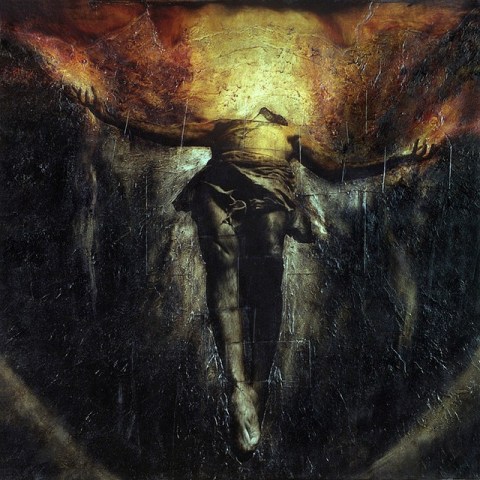
MEL GIBSON’S DEPICTION of Christ’s sufferings in his epic film, ‘The Passion of the Christ’ left deep impressions upon countless audiences the world round. He succeeded in bringing to life the disturbingly cruel and inhumane realities of crucifixion as many Christians have testified to being profoundly moved at the barbaric horror Christ endured to secure our salvation.
However, what Gibson failed even to begin endeavouring to embark upon was Christ’s spiritual suffering that infinitely outweighed His physical agonies. I use the word infinitely because the depths of Christ’s suffering are immeasurable. When Isaac Watts, in one of the most astounding hymns of Christ’s death, penned ‘When I Survey the Wondrous Cross’, it really is a surveying that will endure through all eternity. The height, depth and breadth of our Saviour’s Bitter Cup is the measure of God’s love for us. The Apostle Paul speaks of such love that surpasses knowledge (Ephesians 3:18-19); it is unfathomable. We may taste of it and be overcome – almost crushed with the weight of its revelation and still only know in part.
Some years ago, one respected preacher visited and shared with our church what God had revealed to his heart of the suffering Christ really endured. He only managed to speak a few sentences before he broke down into tears. Not many words were spoken but they were enough to sweep the whole congregation with a solemn profundity that burned in our hearts. We can look, we may gaze and survey, but before long, we will lose the ability to even express in words what is too sacred for description; there we bow; there we lay prostrate before a holy God that stooped so low to redeem us from our wretched hell-bent lifestyles.
If and when God moves to revive His people (and I pray that God would indeed come amongst us once again) and the world around unto a shaking awakening, the cross of Christ will blaze intensely above all other flames. It is the one characteristic of authentic revivals – a vision of Christ lifted up (on the cross) to bear the unreserved agonies of God’s judgement on sin that should have been poured out on all of humanity. Some of the greatest hymns of the Cross have been as a result of a widespread or individual reviving of the heart.
How we know so little if we just focus on the physical aspects of Christ’s death and yet, many stay on that plateaux with acute sentimentality. As gruesome as to what His body endured – beaten to a pulp, marred beyond recognition, the asphyxiation as He struggled to breath by elevating His broken body, rammed through mercilessly with chisel-like nails to humiliatingly hang and slowly die – that is just the surface of the eclipsed hell he was baptized with (Mark 10:38; Luke 12:50). Many speak often of the baptism of the Holy Spirit, but do we think of the baptism of God’s unreserved displeasure of sin executed on His Son?
Christ was never born into this world to be a martyr; He purposely came to drink the cup of God’s wrath against the world’s filth that sets itself against Him and of man’s rebellion that defies Him. For this reason, the Son of God became flesh; Christ came to pay the ransom of souls preordained for salvation. Historically, as some people will object to believing, there have been martyrs who died a more physically gruesome death than Christ and some of which were known to have been singing hymns as their life ebbed away from them.
Christ’s agony commenced in the garden of Gethsemane; He knew what manner of death He was to die, but to consume the dregs of God’s wrath, although He was without sin yet was made to be sin (2 Corinthians 5:21) in order to be the Lamb Who would take away the sin of the world (John 4:29), was profoundly different in nature. Christ stood in our stead to endure our hell, to endure separation from the Father for being made the very substance He could not tolerate to look upon and Whom therefore had to bruise, crush and destroy; that was God the Father condemning our sin in the body of His Son He chose to sacrificially bear (Romans 8:3). So insurmountably great was the crushing weight and pressure upon Christ in the garden, that His intense perspiring was mingled with blood. It was neither the fear of death nor the physical aspect of pain that overwhelmed Him but as Dr Alexander Whyte said, “Death and all its terrors did not much move or disconcert our Lord. No. It was not death: It was sin. It was hell-fire in His soul. It was the coals, and the oil, and the rosin, and the juniper, and the turpentine of the fire that is not quenched.” This is what led the Suffering Servant onto praying, that if at all possible, such a cup be removed, while remaining subservient to the will of His Father.
Although Christ was without blemish, defect and the stain of sin, God the Father imputed our sin to Him in so much as the righteousness of Christ is imputed to us. (Isaiah 53:11; 2 Corinthians 5:21). This was foreshadowed in ancient Israel when Aaron the high priest laid both his hands on the head of a live goat, confessing over it all the sins of Israel and was subsequently sent away into the wilderness bearing the entirety of their sin. Christ likewise suffered outside the gate, outside the camp (in the wilderness) not only to bear the reproach of those who crucified Him, but more so, God Who could no longer look upon Him with favour but with absolute vehemence. The Son of God became as refuse, as dung, in the Fathers eyes. The skin, flesh and dung of the sacrificed bull, under the Levitical priesthood, was burned up with fire outside the camp (Leviticus 8:17); only the best was burned on the altar within the courts (Leviticus 8:16). There never has been anyone as perfectly spotless as Christ, nor will there ever be, who will ever descend to such unimaginable humiliating filth and horror to redeem a people for Himself. If that doesn’t break our hearts, then nothing else will! Not even the angels comprehend such a mystery; what makes us think we will ever fathom the depths of Christ’s substitutionary atonement?
If we don’t gaze beyond the physical aspect of Christ’s suffering, then we are unable to begin apprehending the depth and seriousness of our sin and for why Christ was really sent forth by the Father as a propitiation that made it justifiable for us to be reconciled to Him (Romans 3:26). That God the Father bruised and crushed His own Son (Isaiah 53:10), in order to forgive us, is the right perspective when viewing our redemption, but yet, we hardly hear of this today; modern Christianity doesn’t believe in a God of wrath, only a God of love. How poignant are H. Richard Niebuhr’s words: “A God without wrath brought men without sin into a kingdom without judgement through the ministrations of a Christ without a cross.” In failing to see this, we will not feel the heinousness of sin and the depths that God had to therefore descend in order to reconcile us to Himself and freely justify us by His grace. Furthermore, a misunderstanding of the dire need for Christ’s substitutionary death always results in a washy-washy and cheap evangelism. Consequently, there should be no wonder as to why its converts do not stay in the faith and endure, but return wallowing back in the world’s mire; they were never in the faith to begin with. Soundless gospel preaching will result in non-sound conversions, producing a ‘Christianity’ that is premature and deformed in nature.
 Shade of the Moriah Tree
 Shade of the Moriah Tree